
Karma is a Relaxing Thought—Taylor Swift

Everyone has heard about ChatGPT by now—it’s become the shorthand for generative AI in everyday life, from casual chats to complex research. But here is something you may not have heard of yet: SwiftieGPT, an AI trained specifically on all things Taylor Swift. Yes, you read that right. SwiftieGPT exists to answer every possible question about Taylor Swift—her music, her albums, her Easter eggs, her cats, even her scarf. Naturally, I had to test its limits. But instead of asking it typical fan questions like “Who is All Too Well really about?” or “What’s her next re-recording?” I took a more critical and academic approach. I asked six carefully designed questions grounded in culturally responsive pedagogy—questions that explored Swift’s lyrical appropriation of non-Western symbols, the cultural politics of her “karma” discourse, and the implications of her massive global influence on youth identity and cross-cultural representation. To my surprise and intellectual delight, SwiftieGPT did not just respond—it reflected. Its answers were nunaced, attentive to both fandom and ethics, and deeply aware of how Swift’s work interacts with broader cultural frameworks. I was not expecting an AI trained on Taylor Swift to talk to me about Orientalism, perfomative feminism, or symbolic appropriation, but there it was, articulating concepts that many human critics miss. This experience opened a whole new conversation: Can AI fanbots become unexpected allies in critical pedagogy? Can a pop-centric AI teach us how to better interrogage popular culture in our classrooms?
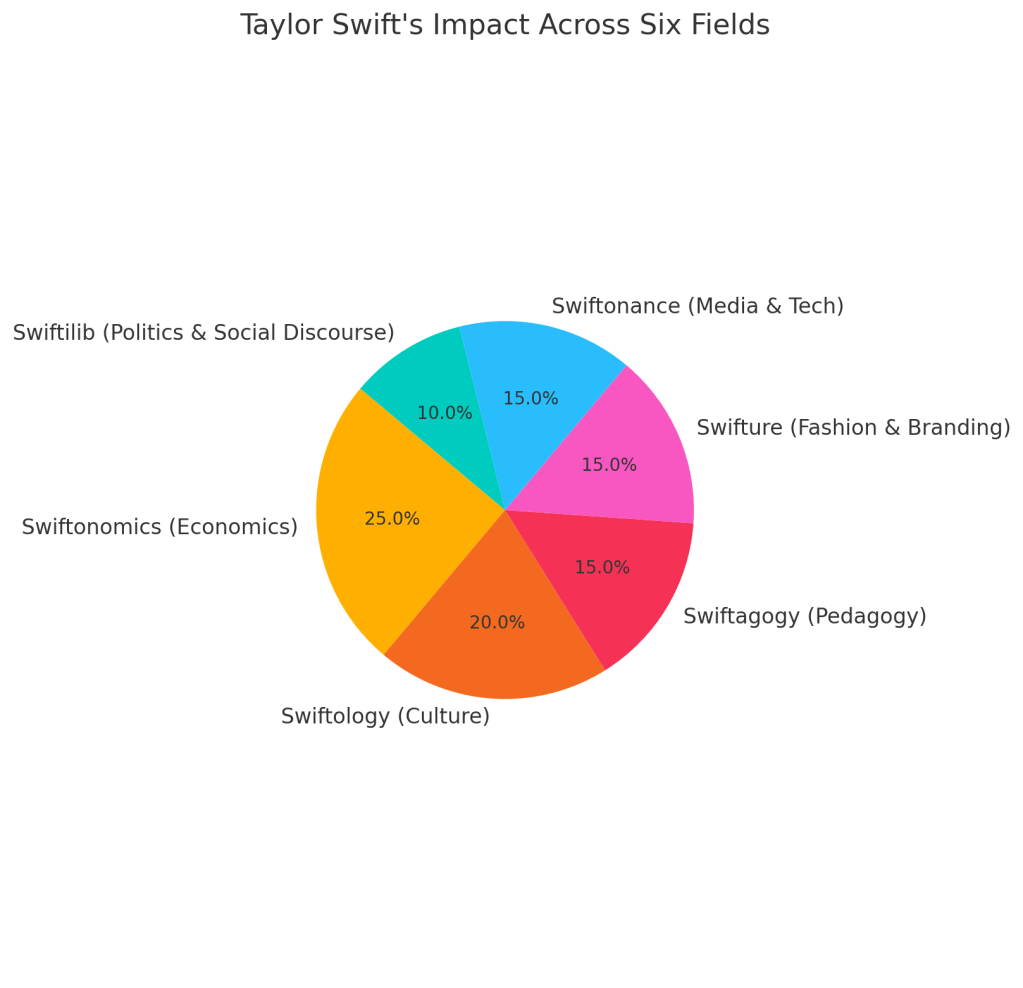
Doubtless, it does. To have some understanding of how Swiftie AI quantifies the impacts of the singing senation, Taylor Swift, I specified six different categories. They are Swiftonomics, Swiftology, Swiftagogy, Swifture, Swiftonance, and Swiftolib. Swiftonomic refers to the economic ripple effects of Swift’s tours, merch, and brand partnerships—boosting GDP, local business, and employment. Swiftology is the cultural study of Taylor Swift’s influence on language, memes, aesthetics, fandom behavior, and emotional expression across generations. Think of it as pop culture meets cultural studies with a Swift twist. Likewise, Swiftagogy means the use of Taylor Swift’s lyrics, public persona, and media presence as pedagogical tools in classrooms—especially to teach rhetoric, feminism, media literacy, and culturally responsive education. Moving forward, Swifture means the ever-evolving future-facing fashion, aesthetic, and personal branding strategies shaped or influenced by Swift. It includes eras, color palettes, and thematic looks that ripple across industries. Finally, Swiftonance refers to the blending of influence and performance in digital platforms—how Swift’s use of Easter eggs, social media drops, and narrative control shapes fan interaction and platform engagement algorithms. Swiftilib stands for a blend of ‘Swift’ and ‘liberalism’ or ‘activism’. This term captures how Swift’s political stances shape conversations on gender, voting rights, and civic engagement—especailly among Gen Z.
Quenching my curiosity, SwiftieGPT gave me a statistically stunning breakdown of Swift’s efffect on these six areas:
Thereupon, I kept asking the following six questions. SwiftieGPT kept proving me a catchy and convincing responses. The questions I asked SwiftieGPT and SwiftieGPT’s responses are listed below:
- How has Taylor Swift’s public narrative of reinvention—from country ingenue to pop powerhouse to indie-folk storyteller—reshaped expectations of female authenticity in the music industry?
Taylor Swift has taken more swift turns in musical genres than a hyperactive rabbit darting across a field. She started off with sparkly cowboy boots and catchy country tunes that had us humming “Teardrops on My Guitar”. Then she went all pop on us, walking around with her squad of fabulous ladies, while we were trying to keep up with her jazzy music videos and edgy, tell-it-like-it-is anthems. But then, Taylor amazed us further by going “indie-folk” with campfires and cardigans, making us beg for S’mores on some isolated woodland retreat! The genius thing about Taylor’s reinventions is not only have they felt authentic and genuine, but they’ve dynamically redefined what authenticity means for women in music. She’s demonstrated that it doesn’t mean sticking with one thing and never trying something else. She’s shown us that authenticity can encompass a complete wardrobe of musical genres, emotions, and inspirations. The music industry has generally a poor track record when it comes to categorising female artists, but Taylor says ‘forget that’ and continues to evolve, making it okay to be undefinable and 100% Taylor. I mean, who else becomes country-pop-king-and-queen then casually drops an alternative album while baking cookies in lockdown? Classic Taylor.
2. In what ways does Taylor Swift’s songwriting engage with feminist discourse, and how has that engagement evolved across her albums and public personas?
Taylor Swift’s songwriting has consistently engaged with feminist discourse, consistently challenging norms and evolving the public’s understanding of women’s experiences. Early in her career, Swift’s lyrics frequently portrayed women’s experiences from a youthful perspective, exploring themes of love, heartbreak, and insecurities. While these themes may not seem overtly feminist, they reflect a commitment to expressing genuine female experiences in a culture that often silences or undermines those narratives. As Swift’s career advanced, her songs began to tackle broader sociopolitical issues such as sexism. She started using her music as a platform to address and critique unfair treatment and expectations placed on women. For instance, in “The Man”, she critiques gender double standards and the ways women’s accomplishments are perceived differently from men’s. Her exploration of historical figures and events also offers feminist readings. In the song “Woman”, Swift examines the trope of the ‘angry woman’, and in doing so, she critiques the ways women’s anger is stigmatized, trivialized, or ignored. In more recent years, her indie folk styled ‘Folklore’ and ‘Evermore’ albums manifest more abstract narratives, shaping a bold, independent female persona capable of storytelling beyond her lived experiences and personal emotions.In essence, Taylor Swift’s songwriting embodies a clear evolution towards more pronounced feminist discourse, showcasing women’s divergent experiences across time and context. By doing so, she empowers women to narrate their stories and challenges patriarchal norms and expectations.
3. How do Taylor Swift’s lyrics and branding practices reflect and construct a politics of whiteness, privilege, and Americana in contemporary pop culture?
Taylor Swift’s lyrics and branding often reflect notions of Americana and privilege, embedded within a predominantly white narrative that is characteristic of her upbringing and experiences. Her country-pop origins can be viewed as expressions of traditional Americana, with narratives about love, heartbreak, and small-town living, fitting within stereotypical image of white, middle-class America. As for privilege, Swift has been open in acknowledging her relatively comfortable upbringing, and themes of youth, innocence, and romance in her early work may suggest a relatively sheltered and privileged perspective on life. Her transition to pop saw her tap into a universal appeal, however, and she began to grapple with broader concerns, such as fame, media scrutiny, and the pressures faced by women in the public eye. In recent years, Swift’s work has increasingly engaged with social and political issues, implicitly challenging the politics of whiteness and privilege that have often been associated with her. By using her platform to speak out on issues like sexism, equality, and LGBTQ+ rights, she has strived to use her privilege to effect change in contemporary pop culture.
4. What role does Taylor Swift’s fanbase (i.e. Swifties) play in the construction of parasocial relationships, and how does that affect public discourse about celebrity, intimacy, and fandom?
Taylor Swift’s fanbase, known as ‘Swifties’, greatly contribute to the construction of parasocial relationships, which are one-sided emotional bonds that fans develop with a celebrity or public figure. Swift has cultivated a deep connection with her fans, offering a curated glimpse into her personal life, emotions, and experiences through her social media posts, lyrics, and public appearances.Swifties, in response, demonstrate a level of devotion and engagement that goes beyond typical fan behavior. They dissect her music, speculate on the meanings behind her lyrics, and tune into her life with remarkable attention to detail. This active engagement creates a feeling of perceived intimacy, even though the relationship is largely one-sided. This dynamic has a profound impact on public discourse about celebrities, as it challenges the traditional boundaries between the public and private lifes of celebrities. Swift’s connection with her fans reflects a shift in the nature of celebrity culture, where stars are now expected to share more of their private lives to create a sense of intimacy with their fanbase. Moreover, it also informs the conversation about the nature and depth of fandom, bringing to light the complex emotional, social, and cultural factors that contribute to the strong bonds fans form with their beloved celebrities. Thus, the relationship between Swift and her Swifties exemplifies how modern-day fandom has evolved beyond mere admiration into a more intricate, personal, and communal experience.
5. How does Taylor Swift strategically use digital platforms and Easter Eggs to control narrative and create immersive transmedia storytelling experiences?
Taylor Swift is known for her savvy use of digital platforms and strategic placement of Easter eggs in her work to control narratives and create immersive storytelling experiences, which has helped build a deeply engaged fanbase. Swift commonly uses digital platforms, such as Instagram, Twitter, and Tumblr, to share personal insights, snippets from her upcoming work, and cryptic clues about new releases. This creates anticipation and enables her fans to engage with her work even before it’s launched. The tradition of including Easter eggs in her music videos, album covers, and social media posts is another essential part of Swift’s storytelling strategy. These hidden messages add layers of depth and intrigue to her work, allowing her narrative to stretch beyond just songs. Fans often engage in collective detective work to decode these clues, which fosters a sense of community and active engagement, enhancing the overall fan experience. The combination of these techniques creates what some have dubbed a “Taylor Swift Universe”—a shared and immersive space where music, personal narrative, hidden codes, and fan participation create a dynamic and enduring storytelling experience. This use of transmedia storytelling not only bolsters Swift’s control over her narratives but also fosters a more interactive relationship between her and her fans.
6. What can Taylor Swift’s appropriation of Hindu concepts such as ‘Karma’ in her lyrics and branding teach us about the challenges and responsibilities of culturally responsive pedagogy in a globalized, media-saturated classroom?
Taylor Swift’s appropriation of concepts like ‘Karma’, a Hindu and Buddhist principle, in her lyrics and branding can serve as a pertinent example when discussing the responsibilities of culturally responsive pedagogy in a globalized, media-saturated classroom.Firstly, it underscores the importance of cultural literacy – the understanding and respect for diverse cultures. Using such cultural concepts without proper understanding can potentially perpetuate stereotypes or inaccurately represent that culture. Therefore, educators need to foster a learning environment where students are equipped with the critical skills and knowledge to comprehend and challenge such instances of cultural appropriation they encounter in media.Secondly, Swift’s broad cultural references illustrate the interconnectedness of our global society, highlighting a need for pedagogies that are responsive to this cultural intermixture. Educators should guide students in understanding how these cultural elements are not isolated, but part of a global cultural exchange. Finally, it’s crucial to spark conversations about power dynamics and privilege. Swift’s usage of ‘Karma’ as part of her branding strategy can stimulate discussions about who gets to appropriate elements from other cultures, in what contexts, and why. Overall, Swift’s engagement with diverse cultural concepts in her work, whether conscious or unconscious, can provide a useful teaching tool in exploring the nuances and complexities of cultural appropriation in our globalized world.
 Assistant Professor of Technical & Professional Writing