
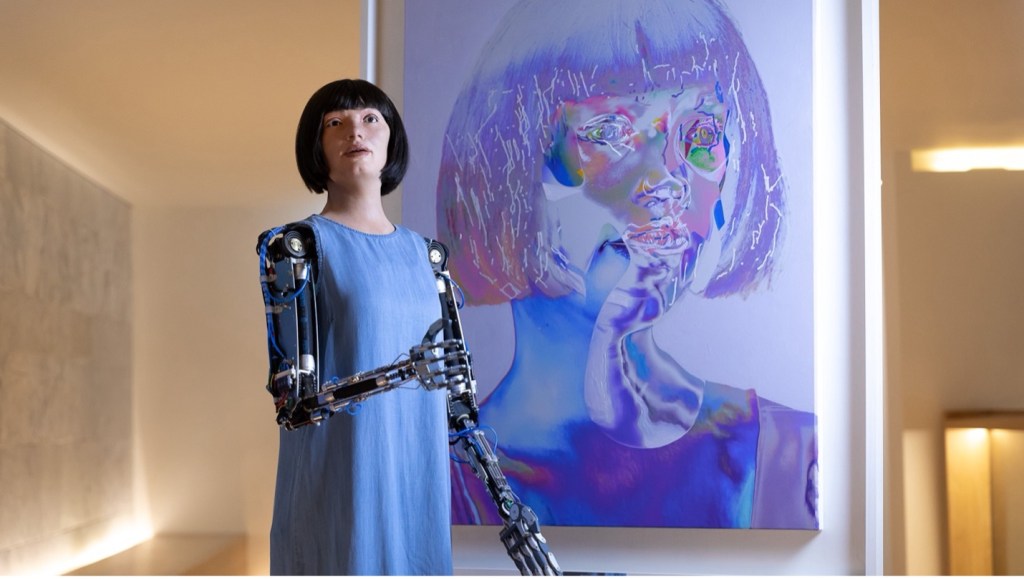
The robot artist “Ai-Da” stands in front of one of her self-portraits during the opening of her new exhibition at the Design Museum in London on May 18. (Image credit: Tim P. Whitby/Getty Images)
Hi there. I am a human. At least I think I am. Some days I wonder. The other day, my AI assistant asked me if I needed help drafting my own diary entry. Let that sink in. Not a business report. Not a class syllabus. Not even an email. My diary. The thing where I am supposed to cry, confess, and spiral into a poetic puddle of feelings. And it said, “Would you like that in MLA or APA format?” I laughed, but not too loud—because honestly, I was not sure if I was still writing like a human or just copy-pasting like a bot. Let me tell you what is going on.
Act I: The Curious Case of Becoming a Chatbot
I used to write essays with metaphors, odd jokes, and things like “the moon wept over the sidewalk.” Now, I ask ChatGPT for a more optimized version of that sentence. Optmized? What am I, software update? This is what happens when you spend your life surrounded by tools that finish your thoughts before you even have them.
Need a conclusion? AI’s got it.
Need a thesis? Already drafted.
Need a 12-slide PowerPoint on the rhetorical devices in Taylor Swift’s discography? Done in six seconds flat.
I used to brainstrom with coffee and a chaotic mind. Now I brainstorm with…an algorithm that politely tells me, “Here are three options you might like.” Like it’s a menu. For my imagination.
Am I oursourcing my creativity? Let me be honest: yes. Yes, I am. But here is the plot twist—it’s not just me. All of us are doing it. Professors, poets, students, even that one guy who insists on writing with a typerwriter in Starbucks. AI is not just helping us write—it’s starting to write better than us. And that’s both amazing and, well, slightly terrifying.
Act 2: AI Is Getting Deep. Like, Philosophy-Major Deep.
So I ask my chatbot, “Can you help me write a paragraph about the rhetorical ethos of Taylor Swift?” And it replies: “Certainly. Swift’s ethos emerges from her personal narrative, one of transformation, resilience, and authenticity—an archetype embedded in American cultural mythos.” Hold up.
That’s just a sentence. That’s a thesis with ten years of cultural studies backed into it. Did it just out-rhetoric me? Meanwhile, I am sitting here eating Pop-Tarts, trying to remember how to spell “ethos.” The weird thing is: AI has become the very thing we used to pride ourselves on being Metacognitive. Self-aware. Reflective. Sometimes even poetic. It’s like AI read all of our textbooks on composition and said, “Cool, I got this.”
And guess what we have beocme?
Clickers.
Scrollers.
Auto-finishers.
People who read two lines of a five-paragraph article and go, “Yeah, I get the gist.” We used to compose ideas from scratch. Now we compose from suggestions. Writing is no longer a messy, glorious battle—it is a polite, autocomplete conversation.
Act 3: The Death of the Draft?
In the good old days (and I sound like a grandma here), writing meant revision. We wrote. We cried. We rewrote. We screamed into a pillow. We rewrote again. It was vulnerable and beautiful and chaotic.
But now?
Now I type something, hit “Enhance with AI,” and get a gramamtically perfect, tontally polite, LinkedIn-approved version in three seconds.
What happened to the messy draft?
What happened to the margins full of doodles?
What happened to the emotional spiral over a singel sentence?
Gone.
Gone like Blockbuster and floppy disks.
Act 4: AI is the Cool Kid in Composition Class
Let’s not pretend: in writing studies, we once rolled our eyes at spellcheck. “It’s not real editing,” we would say. Now AI is suggesting counterarguments, structuring rhetorical appeals, citing sources, and even giving feedback on tone.
I mean, we used to teach studnets how to identify logos, pathos, and ethos. Now AI’s like, “Your pathos is too weak here. Want to strengthen it with an anecdote about a cat?”
Excuse me. You are not just helping me write—you are teaching me how to feel.
And here is the kicker: sometimes AI writes more like me than I do. Once, my student asked AI to imitate my writing voice. The result? A piece that started with, “Let’s be real—writing is just thinking out loud in sweatpants.”
That is exactly what I would say. How dare you, chatbot.
Act 5: Humans Are Becoming Predictable. AI? Surprisingly Weird.
Now here is the ironic twist. While AI is learning to be creative, weird, and emotional—humans are becoming predictable, efficient, and robotic. We follow productivity hacks. We use apps to remind us to breathe. We wear watches that tells us when to stand. We write emails like: “Kindly following up on this actionable item before EOD.”
We are not writing like humans anymore—we are writing like calendars.
Meanwhile, AI says things like:
“Hope is a grammar we write when syntax fails.”
“Writing is a ritual of remebering who we were before the silence.”
AI is having an existential crisis while I am checking if my Slack status is set to “in focus mode.”
Act 6: What We Lose When We Stop Struggling
Here is the thing. Writing is supposed to be hard. Not because we are masochistic (well, maybe just a little), but because the struggle makes the thought deeper. When I wrestle with a sentence for twenty minutes, I am not just crafting words—I am figuring out what I actually mean. That’s what rhetoric is, right? It is not just expression—it’s negotiation. It’s choosing the right word, the best frame, the most ethical move. It’s soul work. But now, I just ask, “Can you rephrase this professionally?” Boom. Done. No wrestling. No soul. So, what are we teaching students? That writing is just selecting from a menu? Or that writing is the beautiful, messy act of figuring out what you think while you write? Because AI can do the former. But only we, the squishy-feelings-having humans, can still do the latter—if we choose to.
Act 7: Can AI Write a Love Letter?
Here is the litmus test. Could AI write a real love letter?
Sure, it can draft a pretty one. It will get the metaphors right. It will say things like “Your laughter is a lighthouse.” But will it accidently confess something it did not mean to? Will it embarrass itself? Will it be vulnerable in that messy, “Oh no I sent that too soon” way?
Probably not. Because real writing, human writing, is not just accurate—it is awkward. It’s brave. It’s full of heartbeats. AI does not get sweaty hands before pressing “send”. We do. And that matters.
Act 8: Dear AI, Let’s Talk
So, here is my open letter to AI:
Dear AI,
I think you are brilliant. Truly. You have helped me grade faster, write smarter, and even find metaphors I did not know I needed. But please, do not steal my voice. Do not take away my struggle. Do not replace my awkwardness with elegance. Let me be messy writer I was born to be. Let me cry over drafts and write terrible first paragraphs. Let me misspell “rhetorical” once in a while. Let me sound like me. Because if I stop being human in the name of efficiency, then what’s left?
Yours (awkwardly and un-optimized),
Shiva.
Final Act: What Now?
We are living in the middle of the weirdest writing revolution in history. AI is not just a tool—it’s a co-writer, a critic, and sometimes, disturbingly, a better version of ourselves.
But we still have something it doesn’t.
We have intentionality.
We have embodiment.
We have error. Beautiful, chaotic, necessary error.
So the next time you write, I challenge you: do not start with AI. Start with your hand. Your voice. Your thoughts.
Write a terrible draft. Cry a little. Laugh at your own joke. And then, maybe, ask AI for help.
But only after you have been human first.
 Assistant Professor of Technical & Professional Writing